

Anthropic launched Claude Meetings in beta on 12 November. It is the best thing that could have happened to the revenue AI category. But revenue isn't won in the meeting, and a general-purpose assistant charges a latency tax that live selling can't afford.
The meeting is not the deal
Claude Meetings tells every board and CRO that an AI working inside the call, not just summarising it afterwards, is now table stakes. Anthropic just spent its launch budget educating our market for us.
But a sales call is not a team stand-up. It is an external conversation where money is won or lost, run against a playbook, inside a deal that started weeks earlier and will run for months after. Claude Meetings is built for the first kind of meeting. Curvo is built for the second.
The beta's own defaults show who it is for. It joins Google Meet as a visible participant. It stays out of calls with anyone from outside your organisation, and leaves if an outside guest joins partway through. Those are sensible choices for an internal planning session. They are the opposite of what a sales call needs, where the most important person on the call is always the outside guest.
A general memory isn't built to learn how revenue is won
A general-purpose model can learn almost anything, given the right data and the right instructions. The question is whether it will be given them. Claude's memory is designed to serve the marketing plan, the board pack and the hiring process equally. Nothing in it is built to connect what was said on a call to whether the deal closed, and that link is what teaches a system what winning sounds like.
Curvo's Revenue Brain is built around one question: what wins revenue, and how does that compound over time? It learns from every call, every deal outcome and every rep, and it gets sharper about your market specifically.
Three things follow from that:
- It is anchored to a playbook. Curvo's suggestions come from a structured, evolving sales playbook: your objections, your competitors, your qualification framework. A general assistant answers from whatever context it was handed, ranked by similarity. That is a search engine, not a coach.
- It runs on structured deal data. Curvo extracts structured relationships from calls, CRM records and inboxes automatically. General assistants mostly retrieve, by text and vector search, from documents someone remembered to connect. You can upload a playbook to Claude, but keeping it current across 200 reps is a job, not a feature.
- It closes the loop on outcomes. Curvo knows which deals closed, which slipped and what was said in each. That is the dataset that turns a suggestion into a winning suggestion, and a horizontal tool has little reason to build it for a single function.
The gap shows up where it matters most: live, mid-call. Curvo's latest real-time pipeline runs at a tenth of the cost of its predecessor and detects 2.7x more of the moments that need a response. That kind of gain only comes from optimising for one job.
Revenue runs on 500 milliseconds
A general assistant sells a latency tax. Live selling has a window of about half a second: the buyer raises an objection, pauses, and the rep has to answer. Help that arrives after that window is a note for next time, not help.
Claude Meetings is built for a different tempo. By default it answers in writing, and Anthropic says that when someone asks out loud, it currently asks each time to confirm who is speaking. Answers that need a connected tool route through that person's permissions first. That is reasonable for a planning meeting. In a negotiation, the moment has passed.
Curvo operates inside the 500ms window, and it does the work while the meeting is still live:
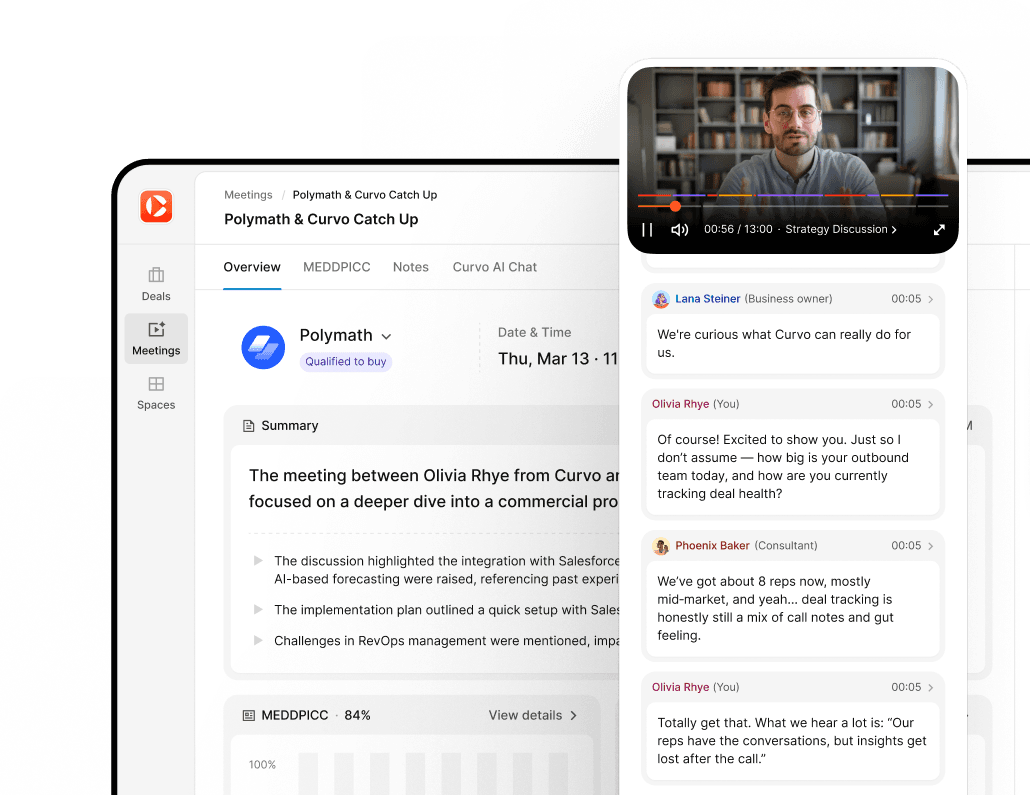
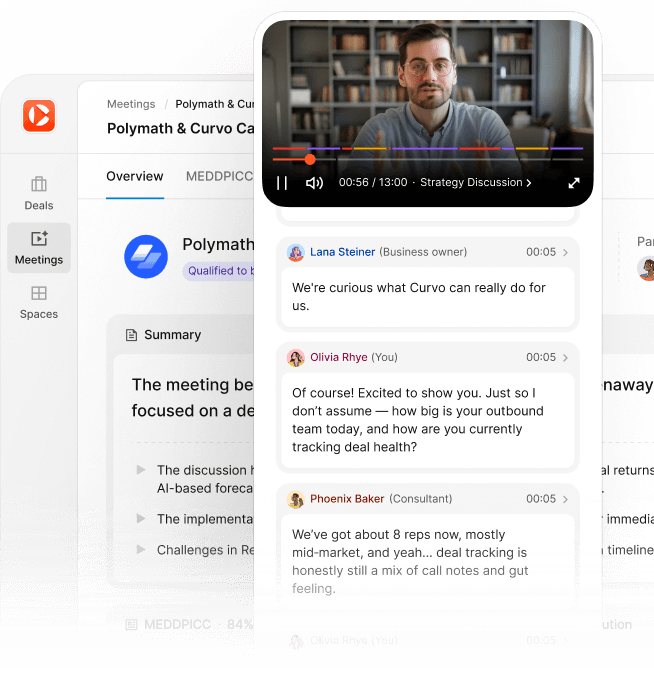
- In-call, not after. Objection handling, competitor positioning and qualification gaps surface the moment the buyer stops speaking, in a private layer only the rep sees.
- Hundreds of special-purpose agents. Reps bring the right agent into the call, from pricing to security review to MEDDPICC, rather than asking one general agent to work out what they need.
- Every meeting ends with next steps. Owners, dates and CRM updates are drafted before the call closes, so nothing waits for someone to write up the notes.
- Efficient by design. Each agent is anchored to the right revenue context and spends only the tokens its job needs, which keeps it fast and keeps it cheap.
Real-time selling is a design problem
Knowing the answer is half the job. The other half is putting it in front of a rep mid-sentence, in a form they can use at a glance while the buyer is still talking. That takes a specialised experience as much as a specialised agent.
General assistants are designed for someone with time to read a reply. A rep on a live call doesn't have that time. Curvo's in-call layer is designed around the rep:
- Cross-sell and upsell signals. When a buyer mentions a new team, region or use case, Curvo flags it along with the product it maps to.
- Information on demand. Pricing, case studies and security answers come from the knowledge base as short cards, not paragraphs.
- MEDDPICC built in. Curvo tracks live which elements of the framework the call has covered, and writes discovery questions for the gaps, specific to this deal.
- Designed for a glance. Prompts are short, ordered by urgency, and stay silent when nothing is needed.
A general provider could build all of this for sales. But it would be building a sales product, and every other function would want the same depth. Specialised agents need a specialised surface to deliver them, and that is the product Curvo has spent two years refining with sales teams.
Infrastructure for revenue agents, not another notetaker
The next wave of sales software won't be features. It will be go-to-market agents that research accounts, prep calls, update the CRM and chase next steps. Those agents are only as good as the revenue context underneath them.
Curvo is that layer. Agent Studio lets teams build agents on top of the Revenue Brain, and voice-triggered agents have been live on Curvo calls for months: a rep can ask for a ticket to be raised or a record updated without leaving the conversation. Claude Meetings showed a similar trick at launch, drawing on whatever tools each person has connected.
The difference is what the agent knows when it acts. A Curvo agent acts with the full deal in view: the playbook, the stakeholders, every prior call and the CRM state. A general assistant acts with what it was given in that session.
That is why teams will build on Curvo as the agentic layer for revenue. It brings together what a revenue agent needs and a general assistant doesn't have:
- Multimodal capture. Video, phone, in-person meetings, chat and email feed one record of the deal.
- Speed and efficiency first. Every pipeline is optimised for latency and cost per call, not raw capability.
- A unified brain. One revenue context across every rep, call and account, not separate memories per person.
- Workflows built in. Qualification, handoffs, follow-ups and forecasting updates come configured for sales, not assembled from scratch.
- Every deal signal. Stakeholder changes, competitor mentions, timeline slips and buying intent, captured as structured data.
- Native integrations. Curvo's HubSpot and Salesforce integrations call their APIs directly. That is more deterministic and more efficient than routing the same task through general-purpose MCP servers, and it means the same field gets the same answer every time.
Curvo is also open by design. It has a public API, an MCP server, and works inside Claude and ChatGPT. Teams that love Claude can keep it. Curvo becomes the revenue system Claude calls when the question is about a deal.
No bot in the room, on any platform
Claude Meetings works by joining the call as a visible participant and posting a notice in the chat. At launch it supports Google Meet only, with other platforms described as coming soon. For an internal sync, a visible AI participant is fine. On a sales call, a bot changes the room. Buyers talk differently when something is visibly taking notes, and procurement teams increasingly ask for bots to be removed.
Curvo captures calls through its desktop app, without a bot joining. It works across Zoom, Google Meet and Microsoft Teams, so it follows the rep, not the buyer's choice of platform. The mobile app extends that to in-person meetings and outbound dialling.
The external-guest rule matters even more. Claude Meetings stays out of calls with outside guests by default, and leaves if one joins. An admin can allow it on those calls, but even then Anthropic says Claude posts its notice in the chat and doesn't reply there. For a rep in a live negotiation, that means no in-call help on exactly the calls that pay the bills.
Curvo's in-call layer is private to the rep and responds in under 500ms, the moment the buyer stops speaking. Consent to transcription still applies, as it does for any recording tool. What changes is that the buyer meets a seller, not a bot.
Side by side
On the capabilities a revenue team actually buys for, the two products are built for different jobs. Claude Meetings details are as published at its beta launch on 12 November 2026.
| Capability | Curvo | Claude Meetings (beta) |
|---|---|---|
| Video platforms | Zoom, Google Meet, Microsoft Teams | Google Meet only; others "coming soon" |
| How it captures | Desktop app, no bot in the call | Joins as a visible participant |
| Customer calls | Built for external calls | Stays out by default, leaves if a guest joins; admin can allow |
| Live help on customer calls | Private in-call layer for the rep, under 500ms | Posts a notice but doesn't reply in chat when guests are present |
| In-person and phone | Mobile app for in-person meetings and outbound dialling | Video calls |
| Sales playbook | Structured, evolving playbooks drive every suggestion | General-purpose; no sales playbook layer |
| Deal context | Revenue Brain links calls, CRM, inbox and deal history | Each person's connected tools, with permission per person |
| CRM write-back | Native, deterministic HubSpot and Salesforce APIs: two-way sync, custom field mapping, MEDDPICC | General-purpose connectors, on request |
| Agents | Hundreds of special-purpose revenue agents, Agent Studio, voice triggers | General Claude with connectors |
| Coaching and team analytics | Rep coaching, post-call analytics, manager views | Notes, transcript and action items per meeting |
| Regulated data | Built for regulated industries: NHS, defence, financial services | Not available in beta to ZDR, HIPAA-ready or CMEK organisations |
| Pricing | Per seat, predictable | Notes free in beta; connector answers count toward usage; artifacts free to 10 Feb 2027, later pricing not disclosed |
| Maturity | In production with enterprise sales teams | Beta |
Seats reward efficiency. Tokens reward consumption
Usage-priced platforms earn more when you use more. That is not a criticism, it is a business model. But it means the vendor's incentives and the customer's diverge on exactly the things that drive cost: how many connectors are queried, how much context is loaded, how often a frontier model is called.
Live revenue AI is the worst case for that model. Analysing every minute of every customer call, for every rep, every day, through a general-purpose frontier model is expensive by design. Claude Meetings already counts in-call answers that use connected tools toward plan usage, and its pricing for meeting artifacts after 10 February 2027 hasn't been disclosed.
Curvo is priced per seat. Our incentive is to make each call cheaper to process, not more expensive, which is why the latest real-time pipeline costs a tenth of the last one. Every efficiency gain we find lands in our margin and our roadmap, not on the customer's bill.
The same discipline runs through the whole product. Curvo's in-call experience and its post-call workflows have both been rebuilt with unit economics as the priority: the right model for each step, the smallest context that does the job, and deterministic integrations wherever an API will do.
Model choice belongs to the customer too. No single model wins on speed, quality, latency and privacy for every task, and the winner changes every few months. That is the bet behind Stripe's agreement to acquire OpenRouter, a gateway that routes requests across more than 400 models from over 80 providers. Enterprises want to pick models on throughput, quality, latency and privacy, without lock-in on cost. A revenue platform tied to one model vendor asks them to give that up. Curvo doesn't.
For a CFO the question is simple. Do you want your revenue team's AI spend to be a fixed line you can forecast, or a meter that rises with adoption? Some token spend will rightly go to general assistants. The revenue budget belongs in a system whose economics are aligned with revenue.
Built for how enterprises buy and govern sales tools
Claude is bought by IT as a horizontal licence for everyone. Revenue tools are bought by the CRO and RevOps against a number: win rate, ramp time, forecast accuracy. Those buyers need a vendor who owns that number with them, and a product they can configure to their process.
That shows up in procurement and in governance:
- Ownership. A revenue team needs one system of record for what was said, what was promised and what changed in the deal. Curvo's field mapping is set up with each customer and writes back to the CRM, so RevOps controls what lands where.
- Governance at scale. With 100 to 200 reps, leaders need a bird's-eye view: which agents are running, what they changed, which reps follow the playbook and which deals are drifting. Per-meeting notes don't add up to that.
- Regulated data. Claude Meetings is not available during its beta to organisations using zero data retention, HIPAA-ready configuration or customer-managed keys. Curvo's data model was built for regulated buyers, with customers across the NHS, defence and financial services.
- A clean buying motion. Curvo is bought on a proposal tied to revenue outcomes, not a pilot that drifts for a quarter. A beta feature inside a general licence has no one accountable for whether it lifts quota attainment.
Where Claude will compete, and where it won't
Claude Meetings will compete hard in general-purpose meeting AI. That market is already crowded: Read AI, Fireflies, Otter, Granola, Notion, the notetakers built into Zoom and Teams, and infrastructure players like Recall making it cheap for anyone to join. Notes and action items are becoming a commodity, and Claude will accelerate that.
That is good news for Curvo. When notes are free, nobody buys a notetaker. They buy outcomes, and outcomes in sales are vertical.
Anthropic seems to agree. Its launch post says it is working with partners including Gong, Fireflies and Otter so teams can send meeting transcripts to the tools they already use. A horizontal platform routing data to specialist tools is not trying to be the revenue system. It is positioning as the layer underneath.
The vertical revenue market is a different contest. It rewards the deepest understanding of how deals are won, the tightest fit with the CRM and the sales process, and live help on customer calls. That is where Curvo has spent two years with sales leaders, and where a general assistant has no reason to go as deep.
Claude in the meeting. Curvo in the deal
We welcome Claude to the meeting. It will make every internal call more productive, and it has told the whole market that AI belongs inside the conversation.
But revenue is not won in a meeting. It is won across a deal, against a playbook, with a buyer who never asked for a bot. That needs a specialist revenue brain, agents built on it, capture that works on every platform, and economics aligned with the customer's number. That is what Curvo is built to deliver.
Sources
- Introducing Claude Meetings, now in beta, Anthropic, 12 November 2026
- Anthropic launches Claude Meetings to turn workplace discussions into plans and tasks, TechCrunch, 10 November 2026
- Anthropic brings Claude Meetings to Google Meet in beta, Dataconomy, 13 November 2026
- Stripe agrees to acquire OpenRouter, Stripe, 19 August 2026